AI Tools for Nurses: The 2026 UK Roundup
AI tools for nurses have gone from novelty to necessity in the space of about eighteen months. The problem isn’t a shortage of options — it’s the opposite. Every week there’s a new chatbot, plugin or “AI for healthcare” product, and almost none of them are written for a UK NHS nurse on a real shift. This is the short, opinionated list of what’s actually worth your time in 2026, what each one is good at, and what to avoid pasting into any of them.
The 30-second answer
Risk = risk to you if patient details go in. Under the NMC Code, that risk is personal.
| Tool | Free? | Data risk | Best for |
|---|---|---|---|
| Trust-approved clinical AI | Via Trust | Lowest | Clinical notes, inside governance |
| Microsoft Copilot (work login) | Chat: often | Lower | Emails, policies, meeting notes |
| ChatGPT | Yes | High if careless | Reflections, CPD, rewriting |
| Claude | Yes | High if careless | Long-form reflective writing |
| Perplexity | Yes | Medium | Guidance look-ups with sources |
| Google Gemini | Yes | High if careless | Google Workspace users |
1. ChatGPT (OpenAI)
The general-purpose workhorse. Best for: rewriting messy notes, drafting reflective accounts, structuring CPD entries, generating patient-friendly explanations from clinical text. Watch out for: never paste identifiable patient data into the free consumer version. See our full ChatGPT safety guide.
Before you try any tool on this list
Same task. One prompt is safe. One is a data incident.
✕ What most nurses type
“Write my Datix for Mrs Patel, bed 12, 84, fell at 03:10 on the 14th after her furosemide…”
Name + bed + age + date + time = identifiable. You are accountable, not the app.
✓ The toolkit version
“Act as an NHS incident reviewer. Using only these de-identified facts: [elderly patient, unwitnessed fall overnight, on diuretic], write a factual, non-blaming Datix summary…”
Same result. Nothing that identifies anyone. Ready to copy.
The toolkit has 200+ prompts already written this way — for handovers, reflections, CPD, Datix and interviews. You stop guessing what’s safe.
Instant PDF · No account · 7-day refund · Endorsed by ANP Damo
2. Microsoft Copilot
If your Trust has rolled out Microsoft 365 Copilot, this is the one to use first. It lives inside Outlook, Word and Teams, runs in your organisation’s data tenant, and is generally permitted for a wider range of NHS work than consumer ChatGPT. See our Copilot for NHS nurses guide.
The real cost of working it out yourself
- • Another evening off rewriting a reflection you already lived through.
- • Trial-and-error prompts that give American, generic answers.
- • One careless paste that you have to report to information governance.
£19.99 is less than most nurses earn in two hours — for prompts you reuse every shift. See the safe prompts ↑
3. Claude (Anthropic)
A strong alternative to ChatGPT, particularly good at long-form writing and careful reasoning. Many nurses prefer its tone for reflective writing. Same data rules apply — anonymise everything.
4. Perplexity
Think Google plus ChatGPT. Best for: looking up clinical guidance, policy summaries and recent NICE updates with sources attached. Always click through to the original source before using anything clinically.
5. NHS-approved clinical AI tools
Tools like TORTUS, Heidi and Tandem AI are being piloted across NHS Trusts for ambient documentation. If your Trust offers one, use it — it’s designed for clinical use and lives inside the approved governance perimeter.
6. Otter / Microsoft Teams transcription
Useful for meeting notes, MDT summaries and personal CPD reflections you record after a shift. Be cautious recording clinical meetings — get consent and check your Trust’s policy first.
7. ChatGPT custom GPTs
Specialist mini-chatbots built on top of ChatGPT — for revalidation, handover structuring, or patient leaflet rewriting. Save your best prompts as a custom GPT once and reuse them in seconds for the rest of your career.
8. Grammarly / Microsoft Editor
Not flashy, but quietly excellent for tidying written work — emails to families, incident reports, CPD entries. Both have AI rewriting features now baked in.
9. Notion AI / OneNote Copilot
For nurses who keep a personal CPD or revalidation portfolio digitally. AI inside your note-taking app summarises long pages, generates structure and pulls reflective themes across years of notes.
10. Google Gemini
A capable alternative if you live in Google Workspace. Same rules: anonymise, don’t paste anything you wouldn’t hand to a colleague on a Post-it.
Which tool should you start with?
If your Trust has Copilot, start there. If not, free ChatGPT covers 90% of what most nurses need — reflective writing, CPD logs, patient communication, policy summarising — provided you treat patient data with the same care you would in any other system. The toolkit matters less than the prompts you build up over time.
Common questions
Can my NHS Trust see if I use ChatGPT on my personal phone?
Your Trust cannot normally see what you type into an app on your own phone and mobile data. But that does not protect you: if patient information ends up in a consumer AI tool, you are personally accountable under the NMC Code and UK GDPR, whoever can see it.
Is Microsoft Copilot free for all NHS staff?
No. Many NHS staff can use the free Copilot chat with their work login, but Microsoft 365 Copilot inside Word, Outlook and Teams is a paid licence that each Trust decides on. Check with your Trust's IT or digital team before you use it for work.
Which AI tool is best for writing NMC reflective accounts?
Free ChatGPT, Claude or Copilot chat all work well. The tool matters much less than the prompt: give it a real, de-identified example and a structure such as Gibbs, then edit the result in your own words.
What happens if I accidentally paste patient data into ChatGPT or Claude?
Stop, delete the chat, and tell your line manager or information governance lead promptly — most Trusts treat it as a data incident that you must report. Reporting quickly is always better than hiding it. The safe habit is to remove names, dates of birth, NHS numbers, bed numbers and rare details before you paste anything.
You now know the tools. The prompts are the part that saves you time.
200+ copy-paste prompts written for UK NHS nursing, already de-identified. Start using them on your next shift instead of building them from scratch.
“This AI toolkit for nurses is brilliant, because it covers using AI safely in the NHS, which is really useful for everyone.”
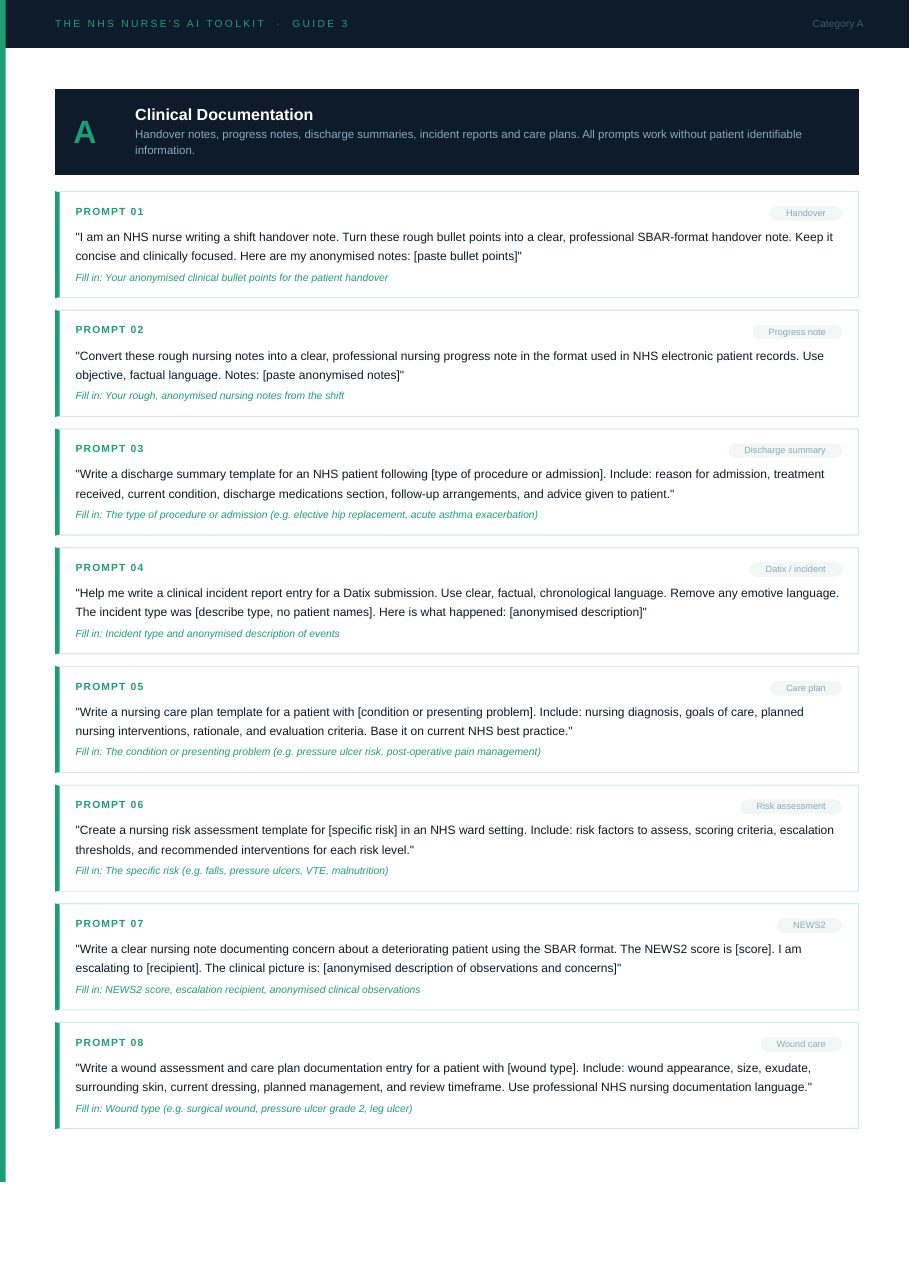
Instant PDF download · No account needed · 7-day refund
See what's inside 50 NHS-Ready AI Prompts for Nurses →Get the free NHS Nurse AI Quick Reference Card
A printable desk reference with the top 8 prompts, safety traffic light, and an NMC revalidation checklist — instantly emailed to you.
No spam. Unsubscribe any time.